
Kilinochchi route
Elephant Pass
The narrow isthmus that connects the Jaffna peninsula to the mainland — and the site of two of the civil war's most defining battles.
Year-round; pair with travel between Jaffna and the south on the A9
Best time to visit
Roadside memorials accessible during daylight hours
Opening hours
Free
Entrance fee
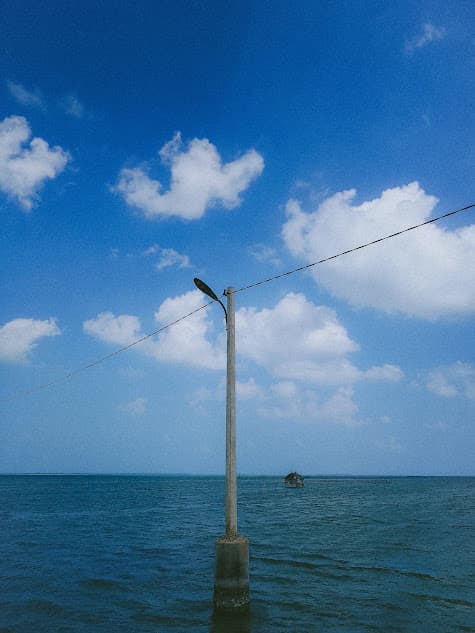
Elephant Pass is the narrow strip of land that joins the Jaffna peninsula to the rest of Sri Lanka. The A9 highway runs across it; the Northern Line railway runs alongside; the salt pans of the lagoon stretch out on either side. For most of Sri Lankan history it has been a strategically essential corridor, and during the civil conflict from 1983 to 2009 it became one of the most contested places on the island.
Two major battles defined the war here. The First Battle of Elephant Pass in July 1991 saw the Sri Lanka Army successfully defend the camp against a sustained LTTE assault. The Second Battle of Elephant Pass in April 2000 ended differently: the LTTE captured the army base after weeks of fighting, in one of the heaviest reverses the army suffered during the war. The peninsula remained largely under LTTE control until the army recaptured Elephant Pass in early 2009 in the final phase of the conflict.
Two roadside memorials anchor the site for visitors today. The Elephant Pass war memorial commemorates the soldiers killed in the defence and recapture of the area; the surrendered LTTE bulldozer — known as the "Elephant Pass D8", an armoured Caterpillar machine that the LTTE attempted to use as a battering ram in the 1991 battle and which is preserved at the site of its destruction — is a smaller but more singular monument. The memorial of Corporal Gamini Kularatne, who destroyed the bulldozer in a grenade attack and was killed doing so, sits beside it. He was awarded the Parama Weera Vibhushanaya, Sri Lanka's highest military decoration, for the action.
The site is a roadside stop rather than a destination in itself. Most visitors travelling between Jaffna and the south, or returning from Chundikulam, pause here for fifteen or twenty minutes to read the memorial inscriptions and to look out across the lagoon. The salt pans, the long flat horizon, and the unusual quietness of the place after the weight of its history are the most direct way to feel it.
For travellers interested in the civil war landscape of the North, Elephant Pass is one of a small number of memorial sites on the A9 that approach the conflict directly. Treat it as a working military area; photography of soldiers or military structures is not permitted.
What to know
Visiting quietly
- Best season
- Year-round; cooler months are more comfortable for walking the memorials
- Etiquette
- These are war memorials and a working military area. Speak quietly. Photography of soldiers and active military installations is not permitted; the memorials and the LTTE bulldozer are fine to photograph.
- Getting there
- 1 hour from Jaffna town south on the A9
A closer look
Location
On the map
Practical things
Frequently asked
Where is Elephant Pass?
What is the Elephant Pass war memorial?
What is the Elephant Pass bulldozer?
Planning a visit to Elephant Pass?
Begin a quiet conversation
Enquire about an Abiholiday villa nearby and Abi will help you plan your trip to the North.
We reply within 24 hours, usually within a few hours.Your enquiry comes straight to Abi's inbox.