
Delft
Delft Wild Horses
A free-roaming herd of small, hardy horses on the open scrubland of Neduntheevu — the descendants, most likely, of animals left behind by Portuguese and Dutch garrisons.
November to March; early morning or late afternoon for active herds
Best time to visit
Open landscape; visit timed by the ferry from Kurikadduwan
Opening hours
Free
Entrance fee
The wild horses of Delft are the image most travellers carry away from the island. A small herd of perhaps a hundred animals roams freely across the scrubland and the grazing plains in the centre and east of the island, drifting between the freshwater wells and the open coast as the day goes on. They are stocky, short-legged, weather-toughened, and almost entirely unconcerned by visitors who keep their distance.
Their origin is the more interesting question. The most credible explanation is that they descend from the cavalry and pack horses left behind in turn by the Portuguese in the 17th century and the Dutch from the 18th, both of whom maintained small garrisons at the fort by the jetty. The British, who inherited the island, are also believed to have used Delft as a stud farm at one point. After the colonial structures were abandoned, the horses were left to themselves and have been semi-feral for several centuries. They are now genetically distinct enough that local researchers describe them as the only true wild horse population in South Asia.
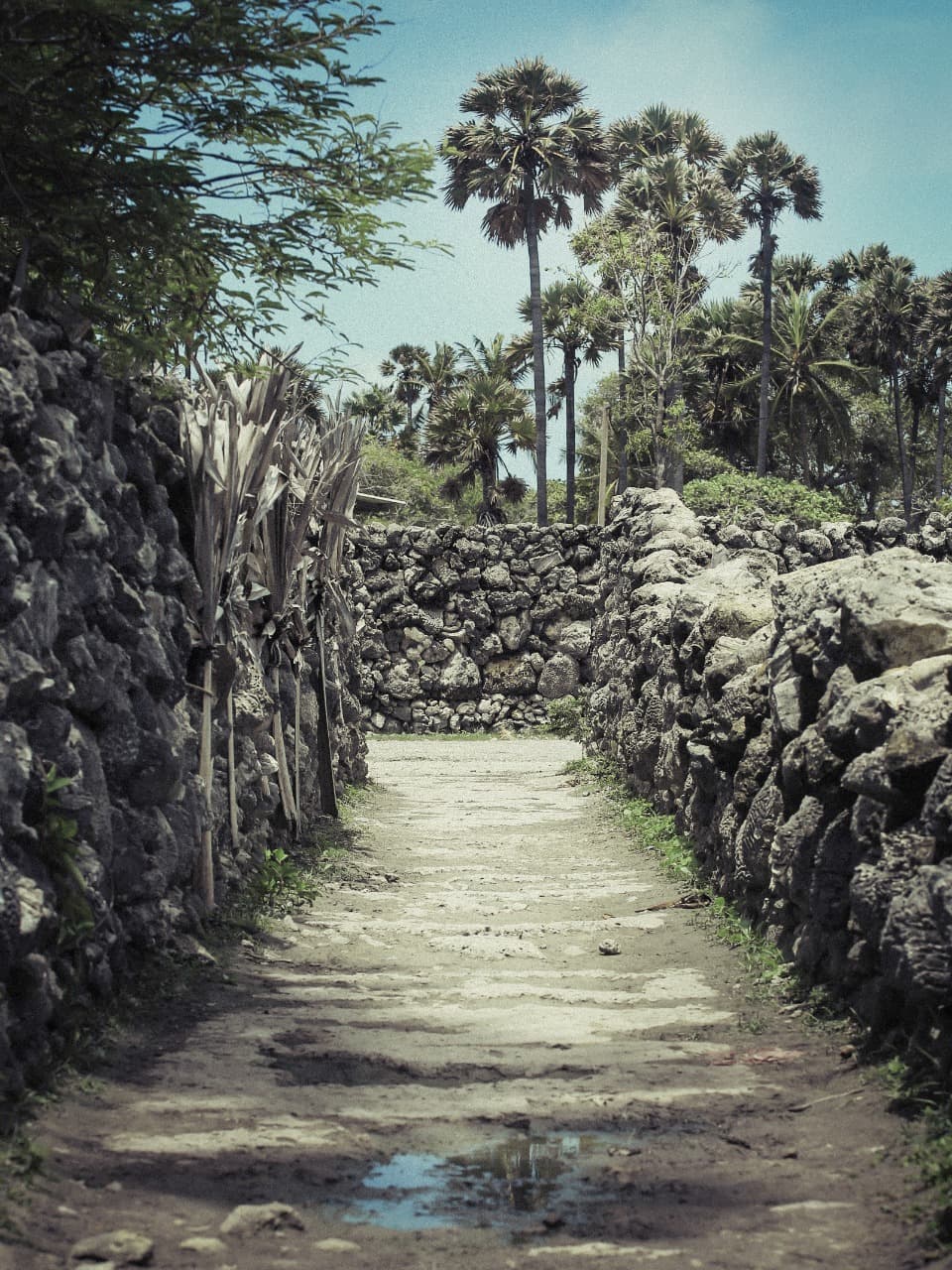
You see them on the standard tractor circuit. The driver will slow on the open stretches and let the herd come into view across the palmyra and the coral-walled fields. They are not domesticated and do not approach for food; the rule is to watch from where you are. A telephoto lens is more useful than a wide-angle one.
The horses are most active in the cooler hours — early morning, late afternoon — and tend to gather around the freshwater wells in the heat of the middle of the day. The Seven Wells area on the western shore is one of the more reliable sightings; the open plain south of Queen's Tower is another.
Take care if you are driving. The animals cross the tracks without warning and the tractor brakes are not always quick.
What to know
Visiting quietly
- Best season
- November to March; the cooler months bring the horses out earlier in the day
- Etiquette
- Do not approach the horses. They are not tame and will move away or kick if pressed. Do not feed them — their grazing economy is fragile and human food is harmful. Photograph from distance with a longer lens.
- Getting there
- 1.5 hours from Jaffna to the jetty, 50 minutes by ferry
A closer look
Location
On the map
Practical things
Frequently asked
Where did the Delft wild horses come from?
How many wild horses are on Delft?
Can you ride the Delft horses?
Planning a visit to Delft Wild Horses?
Begin a quiet conversation
Enquire about an Abiholiday villa nearby and Abi will help you plan your trip to the North.
We reply within 24 hours, usually within a few hours.Your enquiry comes straight to Abi's inbox.